Clarity and Control: Inside the ORBITA ERP Dashboard
Managing the complex web of daily business operations requires a central nervous system—a place where data transforms into actionable insight. For teams overseeing everything from inventory to human resources, the interface they interact with daily isn't just a tool; it's the environment where decisions are made. A cluttered, confusing dashboard slows everyone down, while a clean, intuitive one empowers them. This is where the philosophy behind the ORBITA ERP SaaS Dashboard comes into focus, offering a blueprint for what modern enterprise software should feel like: structured, clear, and inherently scalable.
A Foundation of Visual Clarity
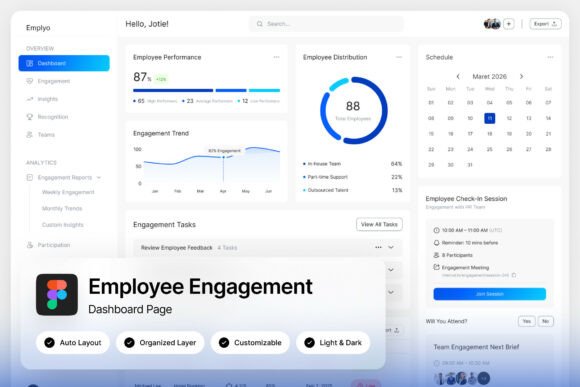
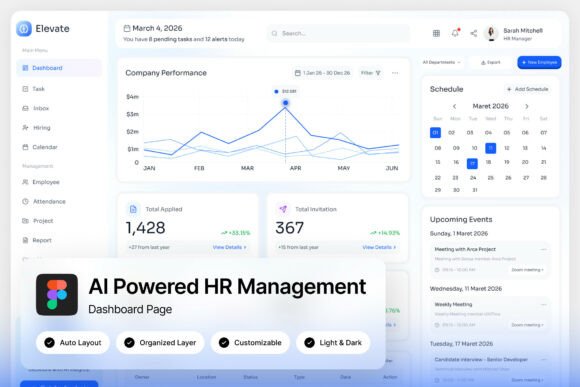
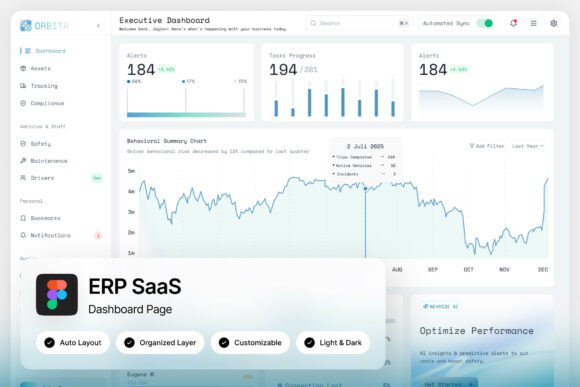
At first glance, the appeal of a system like ORBITA lies in its disciplined, light-themed aesthetic. The blue-and-white layout isn't just a stylistic choice; it's a functional one. Blue, often associated with trust, stability, and professionalism, forms a calming backdrop for the dense information an ERP system presents. The clean white space prevents cognitive overload, allowing key metrics and operations summaries to stand out immediately. This design approach prioritizes readability and visual consistency, which are critical for any tool used across multiple departments. When every team member, from finance to logistics, sees information presented in the same logical framework, alignment and efficiency follow naturally.
For designers and product teams, the value of a well-structured dashboard template extends far beyond its immediate use. It serves as a masterclass in enterprise UX design. The pixel-perfect layout, with its well-organized and named layers, demonstrates how to balance data density with user breathing room. The inclusion of both light and dark mode interfaces acknowledges different user environments and preferences, a thoughtful detail that enhances usability. Studying such a template can inform your own web design and digital product projects, teaching you how to present complex information hierarchies without sacrificing elegance.
Beyond the Screen: Translating Principles to Your Projects
The principles embodied in the ORBITA dashboard—clarity, scalability, and professional presentation—are universal. You don't need to be building an ERP system to benefit from its design logic. Consider how these ideas translate to your own work, whether you're a small business owner crafting your brand's visual identity or a content creator designing social media graphics.
Think about your brand identity. The structured approach of a dashboard like ORBITA can inspire how you organize your brand assets. Using a consistent font pairing—perhaps a clear sans-serif for headings and a highly readable serif for body text—creates the same sense of order and professionalism across your website, packaging, and marketing materials. The dashboard's focus on key performance indicators (KPIs) mirrors how a business owner should highlight their most important metrics or messages in advertising or on a website landing page.
- For Packaging and Merchandise: The clean, modern typography often used in enterprise interfaces translates beautifully to minimalist product packaging. A well-chosen sans-serif font can convey modernity and accessibility, while a subtle serif can add a touch of classic reliability. The layout principles help ensure your packaging communicates essential information without visual chaos.
- For Editorial Layouts and Blogs: The dashboard's multi-module navigation is a lesson in guiding a reader's eye. Applying similar logic to a magazine spread or a long-form blog post helps structure content with clear headings, subheadings, and pull quotes, improving engagement and readability.
- For Marketing Assets: Whether it's a poster, an invitation, or a digital ad, the goal is to present information hierarchically. The ORBITA model shows how to use scale, color, and spacing to direct attention first to the most critical element, then to supporting details.
Making Strategic Design Choices
Choosing the right typeface for your project is a strategic decision that goes hand-in-hand with layout. A dashboard's effectiveness hinges on fonts that are legible at various sizes and under different conditions. This same scrutiny should be applied to your own work. When selecting a premium font for a logo or a key piece of marketing, consider its personality. Does a bold display font capture the energy of your brand, or does a refined script font better suit an elegant invitation? Always test font pairings in context. A beautiful heading font might clash with your chosen body font, so create mock-ups to see how they interact on a page or screen.
Furthermore, practical considerations like commercial licensing are non-negotiable for any professional project. Ensure any creative font you select comes with a license that covers your intended use, whether for digital products, print merchandise, or client work. Many high-quality design assets, including some dashboard kits, include helpful resources like font links and guides, which streamline the process of legally integrating new typography into your workflow.
Ultimately, the ORBITA ERP SaaS Dashboard is more than a collection of charts and menus. It represents a philosophy of design that values the user's time and intelligence. By absorbing its lessons on structure, clarity, and professional presentation, you equip yourself to build stronger brand recognition, create more engaging visual communication, and design assets that are not only beautiful but fundamentally useful. Whether you're mapping out a new enterprise tool or refining the look of your Etsy shop, the core principle remains the same: great design is clear design.